

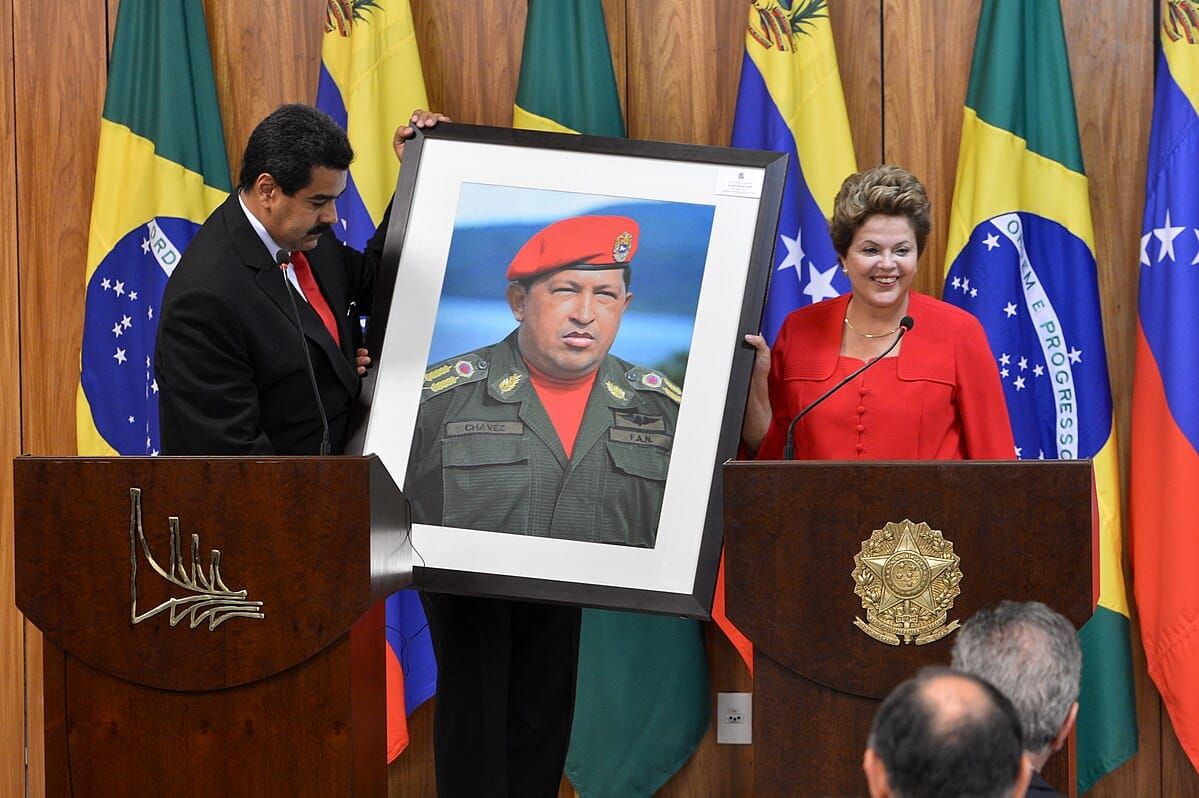
With tensions between the United States and Venezuela at an historic high, Johann de Haas analyses the Maduro regime's iron grip on power, and highlights that opposition to imperialism should not entail uncritical support for autocracy.
An analysis by Johann de Haas (pen name for use in Interregnum)
In the wake of recent attacks by the US and threats by the United States President Donald Trump, the Latin American state of Venezuela has once again become a topic of interest among leftists all over the world. Many have spread calls of solidarity with the authoritarian government of Nicolás Maduro and are condemning the US for their imperialist ambitions.
While standing in solidarity with the Venezuelan people is a noble cause, supporting the government of Maduro and his United Socialist Party of Venezuela is not. Although Maduro uses state propaganda to present himself as a bulwark against US imperialism, in reality he exploits this narrative to entrench the power of his centralized state and to suppress any form of autonomous movements in Venezuela. This is not to say that US imperialism must be supported: it is to say that it should be possible to resist Trump’s gangsterism without inevitably supporting Maduro’s.
The Maduro government continues to speak the language of popular sovereignty and anti-imperialism, but the everyday reality for anarchists, autonomous organisers, and Indigenous communities tells a different story: they face a state that treats autonomous politics not as a contribution to social struggle, but as a threat to its own consolidation of power.
To prosecute those who want to organise themselves outside the regime, the state relies on sweeping criminal categories designed to ensnare anyone who refuses co-optation. Human Rights Watch reports ‘arbitrary detentions, killings, enforced disappearances and torture’ against critics and protesters in the aftermath of the 2024 elections. Amnesty International likewise documents a sharp rise in the criminalisation of civil society organisations, including the use of charges such as ‘incitement to hatred’ and ‘terrorism’ against activists.
These categories are deliberately elastic – and they are rooted in the authoritarian state of Venezuela. Before Nicolás Maduro, his predecessor Hugo Chávez ruled the country from 1999 until his death in 2013 with an iron fist in his own centralized political system, termed Chavismo. A former military official, Chávez mixed elements of socialism, Trotskyism and nationalist ideas – and tried to eliminate organisations and individuals that did not want to be part of his state.
As early as 2006, the Comisión de Relaciones Anarquistas (CRA) warned in an interview with Libcom.org that the Bolivarian state (a term used by Chávez to paint his regime as one following the anticolonial tradition of 1800s revolutionary Simón Bolívar) sought to marginalise all those who rejected both official Chavismo and the traditional opposition. Their stance, a ‘third position’ without loyalty to either state or capital, remains intolerable to a government that treats political alignment as the price of survival. Nicolás Maduro has continued these oppressive Chavista policies to this day.
Indigenous communities face a parallel and often even deadlier form of repression. In 2019, a coalition consisting of the United States, the Netherlands, Brazil, and Colombia tried to deliver humanitarian aid to Venezuela during the attempted coup by the US-backed conservative politician Juan Guaidó. Maduro sent soldiers to the Brazilian border to stop the aid from being delivered. In the town of Kumarakapay, mostly populated by the indigenous Pemon tribe, activists tried to stop the soldiers from advancing in the direction of the border. The soldiers opened fire on the Pemon protestors, killing at least eleven of them, according to a report by Human Rights Watch, with dozens more injured or detained. The massacre of Kumarakapay marked a turning point in the regime’s fight against the indigenous population.
Since then, NGOs and local organisations have detailed ongoing intimidation, enforced disappearances and arrests of indigenous leaders who resisted mining projects or military encroachment. The Venezuelan human rights organisation Foro Penal describes enforced disappearances as a ‘systematic tool’ of political control, also used against community leaders in remote regions.
Those events happen in stark contrast to the self-promotion of Maduro’s government as a protector of the rights of the indigenous population. Like Hugo Chávez before him, the authoritarian president exploits Venezuela’s history of Indigenous resistance to symbolise defiance against foreign interference, framing his own policies as protective.
It’s cynical: while the government claims to defend indigenous rights, it simultaneously kills the people who have inhabited the land for hundreds of years and enables extractive megaprojects, often guarded by the same security forces that criminalise Indigenous resistance.
Through these events, it becomes clear that the oppression of political rivals and the indigenous fight for autonomy in Venezuela is deeply connected. Anarchists, environmental defenders, and indigenous movements put forward forms of organisation that do not depend on the party-state: assemblies, communal self-management, and territorial autonomy. These are not abstract ideals; they are living, and lived, counter-models. And that is precisely the reason that they are treated as threats.
The regime’s instruments of control are well documented:
● Operation ‘Tun Tun’: door-to-door raids following protests, described in reporting by El País.
● Criminalisation through vague charges: Noted by Amnesty International and Human Rights Watch.
● Media smears: Activists cast as ‘foreign agents’ or ‘destabilising forces’, as analysed by Tempest Magazine in its 2025 report on the repression of left-wing movements.
● Disappearances and torture: detailed in the 2025 RFK/Foro Penal report.
These patterns do not distinguish between anarchist students, Indigenous environmental defenders, feminist collectives or left-wing trade unionists. What unites them is a shared refusal to submit to the political logic of the ruling bloc.
For anarchists, anti-authoritarian socialists and indigenous activists alike, Venezuela lays bare how quickly a government that claims to speak in the name of ‘the people’ can turn its machinery against the people’s own autonomous organising. Repression in Venezuela is not a mistake or an excess; it is a deliberate strategy to preserve a political monopoly. One example of that is the so-called plan ‘La Furia Bolivariana’ that was implemented by the government in January of 2024, under the official justification of preventing coup attempts. Shortly after its rollout, unidentified people vandalized the offices of media outlets, civil society groups and opposition parties. From December 2023 to March 2024, at least 48 people, including members of the military, human rights defenders, journalists, and members of the political opposition were detained for alleged conspiracy.
The state does not suppress dissidents because they are violent, nor indigenous communities because they endanger national unity. It moves against them because they show, sometimes quietly, sometimes openly, that another way of living and struggling is possible, one that does not pass through Maduro’s party-state. It is this autonomous possibility, more than any declared ideology, that the government cannot afford to tolerate.
Venezuela illustrates that opposing US imperialism does not require uncritical support for autocratic governance; one can champion Indigenous and communal autonomy while condemning repression that crushes them. It also demonstrates, once again, that the people and the state are not synonymous.
Johann de Haas (pen name for use in Interregnum) is a journalist covering geopolitics, wars, and international conflicts. With a decade of field reporting in regions such as Ukraine and Armenia, he writes to amplify the voices often drowned out by power. His work is driven by a belief that journalism must remain independent and give space to those unheard – from Palestine to Artsakh.
Comments ()