

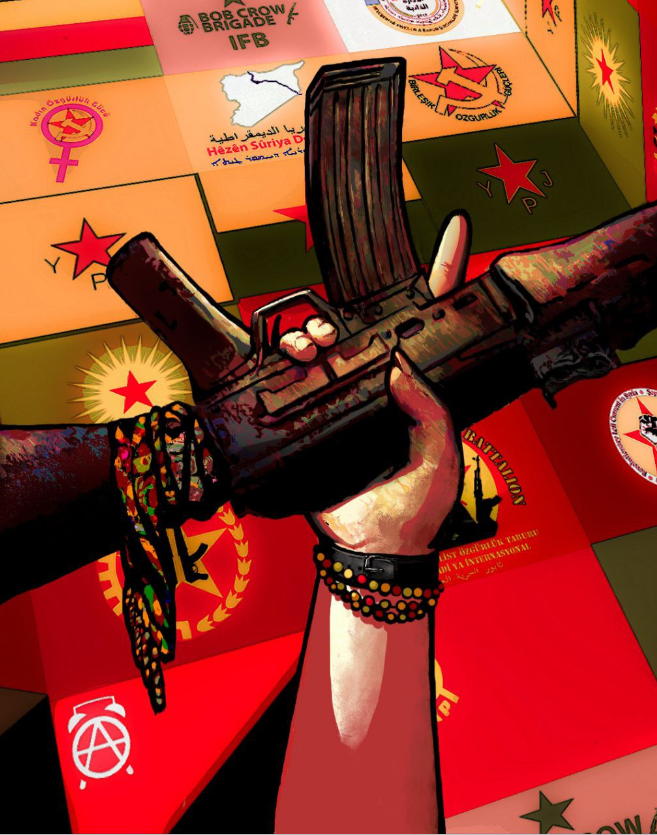
As urgent calls for solidarity emerge from the revolutionary region of Rojava, understanding the historical crossroads that confront social movements is essential. Dr Aynur Unal recounts Rojava's history, and why we must all rally to support one of the world's most important emancipatory projects.
By Dr Aynur Unal
Mesopotamia – now widely referred to as the ‘Middle East’ – was once thought of as the cradle of civilisation. It is now a region defined and shaped by ethnic and sectarian conflicts: the territory has experienced numerous political interventions by the West, especially after the First World War. Justified as a series of interventions to bring regional democracy, the West’s agenda has been on full display in the last decades in Afghanistan, Libya, Iraq and Syria.
When the so-called Arab uprising/Spring occurred, countries in Western Asia experienced a new wave of tension. Since then, Syria has become a site of proxy conflict among multiple international powers, including Europe, the USA, Russia, the regional government, and especially Turkey, which has been fuelling the conflict against the Assad regime and the Kurds. And yet, in the midst of extraordinary levels of violence and political chaos, the Kurds have led one of the most progressive revolutionary projects in human history, whilst simultaneously fighting against ISIS, Turkey’s military, and other local militias. Against all odds, their project has been an exceptional movement that has become a political entity. Rojava’s roots date back to 2012.
Northeast Syria, often referred to as ‘Rojava’ and formally administered by the Democratic Autonomous Administration of North and East Syria (DAANES/AANES), has become one of the Middle East’s most consequential fault lines: a governance experiment under the pressure of war, a frontline in the long struggle to contain ISIS, and a flashpoint for regional powers competing over borders, security, and political status. These parties include the group that currently controls the Syrian transitional government, regional states, and Western countries. These entities, particularly the USA, claim they are duty-bound to introduce democracy to the region; in reality, they are allied to destroy the most advanced form of democracy there.
A Short Historical Recap
The Kurdish Self-Determination Struggle and the Democratic Autonomous Administration of North and East Syria (DAANES/AANES)
For over a century, the Kurds in the region have been struggling for their self-determination and fundamental rights. During that time, they have been denied their existence, marginalised, oppressed, and subject to genocide across the four parts of ancestral Kurdistan in the borders of modern-day Syria, Iran, Iraq and Turkey. The political importance of northeast Syria is closely linked to the broader Kurdish issue spanning these national territories, as well to as the historical context of post-Ottoman borders and the nation-state system that was constructed afterwards.
Kurdish movements consistently challenge a familiar structure: centralised states that see diversity as a security threat and grant citizenship only based on the cultural conformity of what they see as minority groups. In contrast, the model of self-determination adhered to by the Kurds in Rojava and Bakur (also known as North Kurdistan within Turkey's borders) is based on Abdullah Öcalan's interpretation of democratic confederalism. Öcalan was inspired by Murray Bookchin, a social theorist and revolutionary who was concerned with uniting anarchist, communist, and ecological ideas under a sustainable democratic method.
This framing of democratic confederalism shifts the discussion from cultural and fundamental rights granted by the state to political rights, rooted in historical presence and collective agency. When the Syrian state’s control collapsed in parts of the northeast during the Syrian civil war in 2012, Kurdish-led actors and local partners moved quickly to fill the vacuum with new institutions. This development was shaped by years of organisational experience and political debates across the region, including growing scepticism of the nation-state as the only route to rights. The result was a de facto autonomous administration – Rojava – that has tried to govern a multi-ethnic space.
This model advocates for a stateless, decentralised, libertarian socialist system for the Kurds. While it is primarily implemented in North and East Syria (Rojava), it has also been advocated by the Kurdish political movement in Turkey since the 1990s. This movement has also challenged Turkey's national system, established on a single Turkish identity and the Turkish language. In my research on this movement, a key recurring theme is self-identification as a basis for political status: Kurds have frequently framed themselves not as a ‘minority that arrived later’ but as an autochthonous (indigenous) peoples of Mesopotamia (kadim halk) and as a foundational constituent (asli unsur) of the republic’s political story. Post-WWI, during Turkey’s war of independence, Turkish and Kurdish representatives agreed to be allies and build a new state of two nations. This agreement has not been honoured by Turkey.
Since the Rojava administration shares the same ideological roots – democratic confederalism (a decentralised governance model) – as the Kurdish self-determination movement in Turkey and the Kurdish political movement, the DEM Party (a pro-Kurdish parliamentary party) explicitly supports the Rojava revolution alongside support from the Kurdistan Regional Government in Iraq.
One key entity established under the local Autonomous Administration in North and East Syria (AANES) is the Syrian Democratic Forces (SDF), founded in 2015. Its Commander-in-Chief, Mazloum Abdi, is a prominent Kurdish leader and influential figure in north-eastern Syria. The SDF is a diverse coalition comprising Kurdish, Arabic and Christian fighters, though it is mainly controlled by the Kurdish People’s Protection Units (YPG), which was formed three years prior. Another significant revolutionary aspect of Rojava is that women are equal partners in shaping all aspects of life – political, economic, and social. The YPJ, an acronym for ‘Women’s Protection Units’ (in Kurdish: Yekîneyên Parastina Jin), was founded in 2013. It is the all-female brigade of the members of the YPG.
Democratic Confederalism in Rojava and The Role of Women
Democratic confederalism is most closely associated with debates within the Kurdish movement seeking alternatives to the conventional nation-state path. Rather than treating sovereignty as synonymous with a new state, it proposes a model in which democratic legitimacy is built from the bottom up, through local councils, communes, and assemblies that federate across a territory. The principles of the governance model (as they are commonly presented) include:
· Decentralisation and participation: decisions should be made as close to everyday life as possible, not monopolised by distant institutions.
· Pluralism by design: governance should structurally include different communities (ethnic, religious, linguistic), not rely on informal goodwill.
· Social justice and cooperative economics: the model often highlights social welfare and community-oriented economic arrangements.
· Community self-defence: security is framed as protecting society from violence and authoritarian capture, rather than exclusively as a state monopoly.
· Gender equality: women’s participation is treated as a foundational political principle, not an add-on.
Since all principles are crucial both in theory and practice for direct participatory democracy, women's role in autonomy stands out as an exceptional and unique example of women's achievements globally. With the movement, a new concept, Jineology (Kurdish: Jineolojî), translated as the ‘science of women’, is a form of feminism and social science that has become more visible as an extensive and radical perspective on feminism, as well as a criticism of the Western feminist movement. The term has been introduced by the PKK (Kurdish Worker’s Party):
‘Women’ s Liberation Ideology and has become a fundamental scientific term in order to fill the gaps that the current social sciences are incapable of doing. Jineology is built on the principle that without the freedom of women within society and without a real consciousness surrounding women, no society can call itself free’ (Nurhak, 2014, cited in Düzgün, 2016).
Rojava's revolutionary system is thus built on principles of gender equality, ecological sustainability and grassroots democracy, placing it decades ahead of regional norms. Amid Syria’s devastating civil war, Kurdish women have turned their slogan, ‘Jin, Jiyan, Azadi’ (Woman, Life, Freedom), into a lived reality, reshaping not only their community but also their culture.
International attention often focuses on the YPJ (Women’s Protection Units), an all-female militia that played a crucial role in defeating ISIS. These women fought against one of the darkest forces of our time and, in doing so, dismantled patriarchal structures within their own society. Their courage and commitment to justice symbolise hope for both women and humanity. ‘In Rojava, the full exercise of women’s rights is not just an aspiration; it is a reality’, says journalist Debbie Bookchin (Women’s Voices Now, n.d.), whose father, political philosopher Murray Bookchin, inspired this revolutionary system. This feminist vision is proof that systemic change is possible, even in the most hostile environments. It is a model for what women-led societies can achieve when empowered.
To recap, the decentralised governance model emphasises active citizen participation in local government, underpinning their claims to self-determination. A key development in the Kurdish movement was the introduction of ‘democratic autonomy’ and ‘democratic confederalism’ as core elements of self-determination. These models, used interchangeably, enable local participation in decision-making and promote equal opportunities across ethnic and religious groups. Democratic autonomy is defined as ‘a re-grounding of the political status of people, on the basis of self-government rather than on people’s relations with the state,’ (Knapp and Jongerden, 2016). Democratic confederalism focuses on strengthening local councils organised from neighbourhoods to regions. In northeast Syria, these ideas have shaped governance structures combining local councils with broader bodies, aiming to protect diversity and participation in a region dominated by centralising, security-focused state policies. Women have played a crucial role in all these developments.
An Overview of Current Developments
In the past several days, a ceasefire and integration framework between the Syrian government and the SDF (Syrian Democratic Forces)/AANES was announced; it was immediately tested by renewed clashes and a major ISIS-related detention breach. Reporting across Reuters, AP, The Guardian, and Al Jazeera points to a highly volatile sequence: political handover talks paired with intense fighting around detention infrastructure. Reports on headline developments in the SDF-controlled area come from multiple sources and frequently change. Although the SDF leaders keep maintaining diplomatic efforts to avoid any serious conflict in which civilians would be harmed, the Syrian transitional government forces keep attacking SDF-controlled areas.
The ceasefire and integration agreement was reported to involve the handover of key areas such as Raqqa and Deir ez-Zor, along with the incorporation of SDF forces into state structures (Al Jazeera, 18 Jan). A few days ago, reports emerged about clashes near Shaddadi (Hasakah countryside), with Syria’s Interior Ministry stating that approximately 120 ISIS detainees escaped from a prison. Kurdish sources reported a significantly higher figure. According to Mena Today, on 23 January, Syria’s interim Minister announced that they had seized control of al-Aktan prison in Raqqa, northeastern Syria – a facility previously managed by the Kurdish-led SDF. The immediate risk is that instability around ISIS detention sites creates opportunities for them to escape, recruit, and renew operational networks. The longer-term risk, on the other hand, is that if governance and security arrangements are reshuffled without credible protections for local participation and rights, the region may slide toward a security-dominated settlement that reproduces the very grievances that have driven conflict for decades.
The SDF official publicity account updates on any development regarding ongoing clashes and diplomacy efforts on ceasefire. According to ANHA, as of 23 January 2026 ‘the Syrian Democratic Forces and the Women's Protection Units continue their military deployment, and the general mobilization and alert continue throughout the region, with an intensive security presence in all towns and cities’. These developments indicate that the leaders of the Autonomous Administration are making a significant diplomatic effort for a ceasefire. However, they have also been willing to fight due to the mistrust of forces led by the Syrian transitional government.
Solidarity with Rojava for Universal Democratic Values
External supporters cannot ‘solve’ northeast Syria from afar, but they can reduce harm, strengthen credible civilian institutions, and push governments to stop treating ISIS detention and camps as someone else’s problem. In fast-moving conflict environments, misinformation travels faster than ambulances.
Use party sources (including SDF and state channels) as position statements, not as neutral reporting. Cross-check against multiple outlets and the AANES/DAANES official statements. It is crucial to raise awareness about the revolution in Rojava and the recent systematic violence targeting it, because civilians, along with an advanced democratic political unity, are under attack by the self-declared, imperialist-backed Syrian government.
As I emphasised earlier, the Kurds have been fighting for their fundamental rights for over a century and have demonstrated that a society based on active participation, gender equality and ecology is achievable, not just a utopian idea. The attack on this Kurdish led- entity is poised to have multiple catastrophic consequences across the region, impacting domains such as:
· ISIS containment: prisons and camps in the region hold ISIS detainees and families, creating a persistent security and humanitarian challenge.
· Regional stability: shifts in control can trigger displacement, disrupt services, and alter cross-border security dynamics.
· Political precedents: AANES is a real-world test of decentralised, plural governance under conditions of conflict.
· Geopolitical leverage: control over agricultural land, oil and gas infrastructure, and key routes makes the region strategically valuable.
· Massacres of local people, mainly targeted at Kurds.
· Forced displacement and demographic change.
If you have a platform (academic, media, civil society), consider:
· Teach-ins and briefings that explain the governance model, the security dilemma (ISIS prisons/camps) and the regional power contest without romanticising any actor.
· Amplifying civilian voices across communities (Kurdish, Arab, Assyrian and others), not only armed or party leadership.
· Supporting research, documentation and translation work that helps international audiences understand constitutional and rights debates in Syria’s Northeast.
To conclude, Northeast Syria holds significant importance because it functions as a model of revolutionary, democratic, pluralistic self-governance, acts as a security barrier against ISIS's resurgence, and serves as a bargaining tool in a broader regional context that has yet to settle the Kurdish and marginalised communities' political status.
The events of the last few days illustrate how swiftly ‘political processes’ and ‘security failures’ can intersect. Achieving a lasting resolution will require more than just military transfers. It will demand constitutional protections, accountable institutions, and a credible strategy for managing ISIS detainees that doesn't merely shift the risk onto local groups. Syria’s self-appointed president, Ahmed Al-Sharaa, had recently cancelled planned visits to Germany and Davos; the reason was the ongoing civil society struggle against the atrocities inflicted upon the Autonomous Region.
It is extremely concerning that the global powers have been more than turning a blind eye to ISIS-led atrocities in Syria. They are either watching each other’s moves or openly supporting the so-called new Syrian government, which they had previously labelled a terrorist group. Every second is more important for people on the ground. We need solidarity now more than ever. As Kurds across Kurdistan and around the world express solidarity with the Peoples of Rojava, I believe it is everyone’s responsibility to join them — especially those who value democracy, human rights, unity and self-determination for all.
Dr Aynur Unal is currently an Associate Lecturer at Arden University, England. She holds a PhD in Political Sociology from the University of Leicester, U.K. (2019), an M.A. in International Relations (specialised in International Law and Human Rights) from Deakin University, Australia (2016) and a B.A. degree in International Community Development from Victoria University, Australia (2014). Her interdisciplinary research interests include indigeneity, ethnicity, indigenous rights, Kurdish political movements, indigenous peoples of Mesopotamia (Middle East), internal colonisation, post-colonial nation states, self-determination movements, indigeneity discourse, national identity discourse, political communication and Critical Discourse Studies (CDS).
Sources
Women’s Voices Now (n.d.), A Revolutionary Model of Equality. Available at: https://www.womensvoicesnow.org/womens-revolution-in-rojava
van Wilgenburg, Wladimir, Syrian Democratic Forces (Syria), European Council of Foreign Relations. Available at: https://ecfr.eu/special/mena-armed-groups/syrian-democratic-forces-syria/
Knapp, Michael, and Joost Jongerden. (2016). “Communal Democracy: The Social Contract and Confederalism in Rojava”. Comparative Islamic Studies, 10 (1), pp. 87-109.
Unal, A (2022). Struggle for Self-Determination: The Kurds and Mesopotamian Indigeneity. Available at: https://www.philosophy-world-democracy.org/posts/article/struggle-for-self-determination-the-kurds-and-mesopotamian-indigeneity
Düzgün, Meral. "Jineology: The Kurdish Women’s Movement." Journal of Middle East Women's Studies, vol. 12 no. 2, 2016, p. 284-287. Project MUSE, https://muse.jhu.edu/article/625064.
Organisations and channels worth following or supporting
· Democratic Autonomous Administration of North and East Syria (DAANES) official site and statements: https://daanes.org/en/
· Syrian Democratic Forces (SDF) press channels (party source; read critically): https://www.sdf-press.com/
· Kurdish Red Crescent (please donate): https://heyvasor.com/en/donation/
· Rojava Information Centre (RIC) for English-language briefings and media resources: https://rojavainformationcenter.com/
For tools, organising resources, and more information, we highly recommend this resource by the Kurdistan Solidarity Network: https://kurdistansolidarity.net/2026/01/21/tools-and-resources-for-defending-rojava/
Finally, we would like to promote the People's Caravan to Rojava, a collective effort to access and defend Rojava. Please read their statement below:
'As people from all organizations, ages, and countries—women, young people, internationalists, journalists, teachers, healthcare workers, revolutionaries, and members of international and humanitarian aid organizations—who want to create a free life in all regions of the world, we call on you to join us in a convoy to the borders of Rojava. These borders, imposed by authoritarian regimes, are crumbling as the Kurdish people flock to stand in solidarity with the peoples of North and East Syria. We must now join them and travel to Kobanê, a historic symbol of resistance against ISIS that was liberated by courageous women and men in 2014. Kobanê is currently under siege and is once again threatened by fascist Islamist gangs." According to information shared on Instagram, people will gather starting today to travel to Rojava via four different routes. Contact details for participating in the campaign are as follows: "If you wish to join, support, or assist us in making this caravan a success, you can reach us via Signal at @caravankoban. 15 or +491521782023 or via email at KobanCaravan@proton.me.'
Comments ()