

Johann De Haas deconstructs the latest foreign policy blunders by the US empire, and foregrounds the racist echo chamber that dominates US foreign policy: Iran is perceived as an irrational and fanatical actor rather than as a legitimate and coherent political and social force.
By Johann de Haas
The largest US military build-up in the Persian Gulf in decades was sold in Washington as proof that empire still works on command. From late January 2026, the Trump administration deployed carrier strike groups, advanced fighters, and missile defenses into the region, insisting that sheer firepower could coerce Tehran into accepting a “better deal” on its nuclear and missile programs while taming Iran’s regional networks.
The central reality that has since emerged is brutally simple: The United States overestimated its own military power and brutally underestimated Iran.
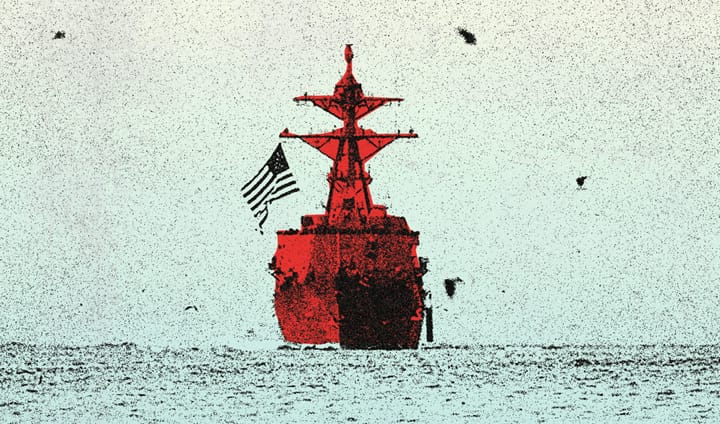
By late February, the Pentagon had assembled at least two aircraft carrier strike groups in and around the Arabian Sea and Gulf, centered on the USS Abraham Lincoln and the USS Gerald R. Ford, alongside some sixteen other US Navy vessels, guided‑missile destroyers, and support ships. Military reporting and open‑source tracking documented a parallel surge of F‑22s, F‑35s, F‑15E strike aircraft, refuelling tankers, and E‑3 AWACS to bases in Qatar, the UAE, Kuwait, and elsewhere, described even by sympathetic outlets as the largest concentration of American airpower in the region since the invasion of Iraq in 2003.
Analysts quoted by Responsible Statecraft and other outlets noted that while some assets were defensive, the posture clearly enabled a sustained air and missile campaign against Iranian targets, from nuclear facilities to air defenses and Islamic Revolutionary Guard Corps (IRGC) bases.
Trump publicly framed this as a countdown: Iran had “10 to 15 days at most” to accept US demands, implying that the presence of overwhelming force would translate into overwhelming political leverage. In other words, the build‑up was not just military theater; it was meant to prove that US imperial power still sets the terms of political life in the Gulf.
Trump failed to foresee Tehran's retaliation
That assumption ran directly into the hard limits of what conventional superiority can achieve against a state built around asymmetric deterrence. Years of research on Iran’s security doctrine show a consistent pattern: confronted with sanctions, encirclement, and threats of regime change, Tehran has invested in dispersal, underground “missile cities,” and a layered mix of ballistic missiles, drones, cyber tools, and allied militias rather than trying to match US platforms ship for ship or jet for jet. Studies of Iran’s proxy network describe this as “forward defense” — a strategy that pushes confrontation outward via Hezbollah, Iraqi militias, Yemen’s Houthis, and others to raise the costs of any US or Israeli assault.
A 2025 analysis of Iran’s military posture published by the International Journal of Academic and Applied Research concluded that these moves are primarily defensive reactions to decades of US pressure, not evidence of some irrational drive for regional hegemony. Yet in early 2026, Washington behaved as if parking more high‑value hardware a few hundred kilometres from Iran’s coast would automatically make that doctrine evaporate.
This is where the miscalculation becomes clearest. Mainstream and critical analysts alike, for example in an article written for The Institute for Peace & Diplomacy, warned that a US strike could trigger exactly the kind of retaliation – on Gulf oil infrastructure, US bases, and shipping through the Strait of Hormuz – that the build‑up was supposed to deter. Responsible Statecraft, for example, outlined scenarios in which Iran would respond not by collapsing, but by activating its “asymmetric toolkit”: precision‑guided missiles, drones, cyber attacks, and proxy operations targeting US forces and allied regimes.
That is precisely what unfolded once the United States and Israel moved from coercive signalling – deliberately using threats, limited force, or other pressure tools to send a clear message intended to change another state’s behavior – to open attacks in late February, hitting Iranian air defenses and selected Revolutionary Guard facilities. Iranian forces and allied groups responded with waves of missiles and drones against Gulf states; by mid‑March, reports suggested that more than 2,000 projectiles had been launched at countries such as Qatar, Saudi Arabia, the UAE, Bahrain, and Kuwait, striking airports, oil facilities, and military installations. Al Jazeera and Reuters documented attacks around Dubai International Airport and other sites, turning the US basing network itself into a dense map of targets rather than a platform of unchallenged power projection.
An imperial war
From an anti‑imperialist perspective, this is not an accidental tragedy but a structural feature of US strategy. For decades, Washington has ringed the Gulf with bases and “defense partnerships,” promising monarchies like the UAE that hosting US forces would guarantee their security. In practice, 2026 has exposed what a Responsible Statecraft analysis calls the “perils” of this posture: sprawling, fixed installations that cannot be adequately defended from missile and drone swarms, and which drag host societies into the line of fire whenever Washington escalates.
Jacobin and other left publications have long argued that these arrangements are not about democracy or stability, but about securing an imperial order built on Gulf oil flows, arms sales, and the projection of US power across the wider region. The current crisis confirms that logic: the bases are less shields than tripwires, tying local infrastructures and populations to the fortunes of US war planning.
The Trump administration’s own decision‑making environment amplified these structural pathologies. Academic work on US policy toward Iran since 1979 describes a “hostile path” in which Washington oscillates between sanctions, covert pressure, and threats of force, rarely questioning the premise that Iran must be contained or punished rather than treated as a legitimate regional power.
Geopolitics from inside the echo chamber
Trump’s first term already demonstrated how this hostility is fused with narcissistic improvisation: withdrawal from the JCPOA, assassination of Qassem Soleimani, and maximalist sanctions pursued without a credible diplomatic off‑ramp. A Harvard study of Trump's Iran rhetoric identified systematic use of Orientalist and racialized tropes – painting Iran as inherently dishonest, violent, and uncivilized – as part of the political selling of these policies.
In his second term, those habits reappeared in the 2026 build‑up: officials floated alarmist and intelligence‑contested claims that Iran was weeks away from fielding missiles capable of striking the US mainland and might develop a nuclear weapon within “two to four weeks,” using these talking points to justify rushing towards confrontation.
Inside this ideological echo chamber, genuine warning signs were side-lined. Reuters has reported that Trump was explicitly briefed before the February strikes that Iran might retaliate not only against US assets, but against Gulf allies and shipping in and around the Strait of Hormuz. Intelligence assessments did not promise such retaliation was certain, but they clearly flagged it as a serious possibility, contradicting Trump’s later claim that Iran’s response was a shocking, unforeseeable escalation. Critical think‑tank and media analyses likewise stressed that any serious attempt by Iran to close or disrupt Hormuz – even temporarily – would trigger a global energy crisis, potentially sending oil prices well above 200 dollars per barrel and fracturing the coalition the US claimed to lead.
Yet, as Jacobin has emphasized in its broader treatment of US wars in the region, the political class remains convinced that control over these chokepoints is a necessary attribute of global hegemony, even when that control becomes increasingly fragile. The result is a pattern in which empire repeatedly gambles with world‑system stability, assuming others will absorb the costs.
Iran’s deterrence strategy was openly known
Iran, for its part, had openly signalled the contours of its deterrence strategy long before 2026. Israeli and regional security institutes have documented how Tehran and allied organizations drew lessons from the 2006 Lebanon war and subsequent conflicts: dispersing assets, building deep underground tunnels and bunkers, and massively expanding rocket and missile arsenals to expose the “balance of vulnerability” on which US and Israeli air supremacy once rested.
Studies of Iran’s proxy networks show how Hamas, Hezbollah, Iraqi militias, and the Houthis have been integrated into what Tehran calls an “Axis of Resistance,” calibrated to pressure adversaries on multiple fronts rather than win conventional set‑piece battles. A newer analysis by Geopolitics Central from early 2026 suggests that the Islamic Revolutionary Guard Corps has codified an “offensive asymmetric doctrine” in which resilience, regional escalation, cyber operations, and energy disruption are phased responses to any major attack, culminating in efforts to make Hormuz uninsurable and unusable for global shipping. These are not secrets; they are publicly discussed by Iranian media, think tanks, and Western researchers alike.
How racism shaped foreign policy
From this angle, the US misreading of escalation dynamics is less a technical error than a refusal to take Iran’s strategic thought seriously. Studies of US and Iranian “terrorism” discourse show how Washington routinely reduces Iran’s actions to fanatical aggression, while Tehran frames its own policies as resistance to Western domination. Critical discourse analysis of New York Times coverage after 9/11 documented how Iran was consistently portrayed as a “negative Other,” an irrational part of an “axis of evil,” smoothing the way for public acceptance of sanctions, threats, and military options.
Work on American cinematic representations of Iran likewise shows a steady pattern of depicting the country as backward, violent, and hostile to human rights, narratives that are easily instrumentalized by foreign‑policy elites. When such racialized and Orientalist imaginaries saturate the political culture, it becomes easier for decision‑makers to believe that Iran will simply fold under pressure, that its leaders are too “irrational” or too terrified by US might to play the long game.
The Gulf region as an “imperial space”
At the same time, the United States approaches the Gulf as an imperial space whose primary function is to stabilize global capitalism, rather than as a region of societies with their own political trajectories. As Jacobin has argued, control over Gulf oil and shipping remains central to US strategy, even if Washington is less directly dependent on those supplies than in previous decades; what matters is the ability to set the terms under which others – Europe, China, the Global South – access those flows.
The UAE, for example, has spent decades buying US weapons, hosting key facilities like Al‑Dhafra and the Jebel Ali port, and integrating itself into what one Jacobin piece calls a system of “coercive capitalism” anchored on American military protection. Yet in 2026, that same integration turned Emirati and other Gulf cities into front‑line zones, as Iranian missiles and drones hit near airports and oil infrastructure while residents were told to shelter or evacuate. A New Yorker interview on Trump’s Iran war captures the resulting anxiety among Gulf elites: they see a US–Israeli campaign that may be tactically effective but lacks any coherent plan for the day after – and they fear Trump could lose interest and walk away, leaving them exposed to the consequences of a wounded but surviving Islamic Republic.
The racialized hierarchy underpinning this system is not limited to Iran policy, but it is starkly visible there. Scholars like Jasmine Gani have shown how Western powers historically cast the Middle East as a space of civilizational infancy, to be tutored, disciplined, or punished rather than engaged on equal terms, a logic that has informed everything from mandate rule to coups and invasions. Historical work on US policy toward Iran in the 1950s traces how “orientalist perceptions” of Mohammad Mossadegh as irrational and weak helped legitimize the CIA‑backed coup that restored the Shah, intertwining anti‑communism with contempt for Iranian self‑determination.
This older Orientalism now intertwines with Islamophobia and open racism, shaping decisions like the withdrawal from the Joint Comprehensive Plan of Action (the deal about Iran's nuclear program) and the travel ban. In 2026, this civilizational arrogance continues to manifest in the assumption that an overwhelmingly white, Western military machine can simply compel a non‑Western state – with its own history of anti‑colonial struggle and its own regional ties – to accept dictated terms, and that any resistance must reflect irrational fanaticism rather than rational strategic calculation.
Systemic failure
Seen from a left‑radical, anti‑imperialist perspective, the 2026 Gulf crisis is therefore not just a botched operation but a systemic failure baked into the structure of US power. Empirical studies of US military strategy in the Gulf have long found no clear link between heavier US deployments and greater regional stability; in many cases, heightened presence coincided with more frequent or intense conflicts. The current build‑up follows the same pattern: Washington doubles down on military instruments to manage political contradictions – its alliance with authoritarian Gulf rulers, its unconditional support for Israel, its hostility to Iranian autonomy – rather than addressing those contradictions at their root.
When the resulting spiral produces missile strikes on Dubai, panicked Gulf publics, and a choked‑off Hormuz, the system responds not by questioning empire itself, but by calling for more air defenses, more carriers, more “credible” threats. The miscalculation in 2026 is thus not an aberration; it is a predictable outcome of an imperial order that confuses the ability to deploy violence with the ability to shape history.
Johann de Haas (pen name for use in Interregnum) is a journalist covering geopolitics, wars, and international conflicts. With a decade of field reporting in regions such as Ukraine and Armenia, he writes to amplify the voices often drowned out by power. His work is driven by a belief that journalism must remain independent and give space to those unheard – from Palestine to Artsakh.


Comments ()