

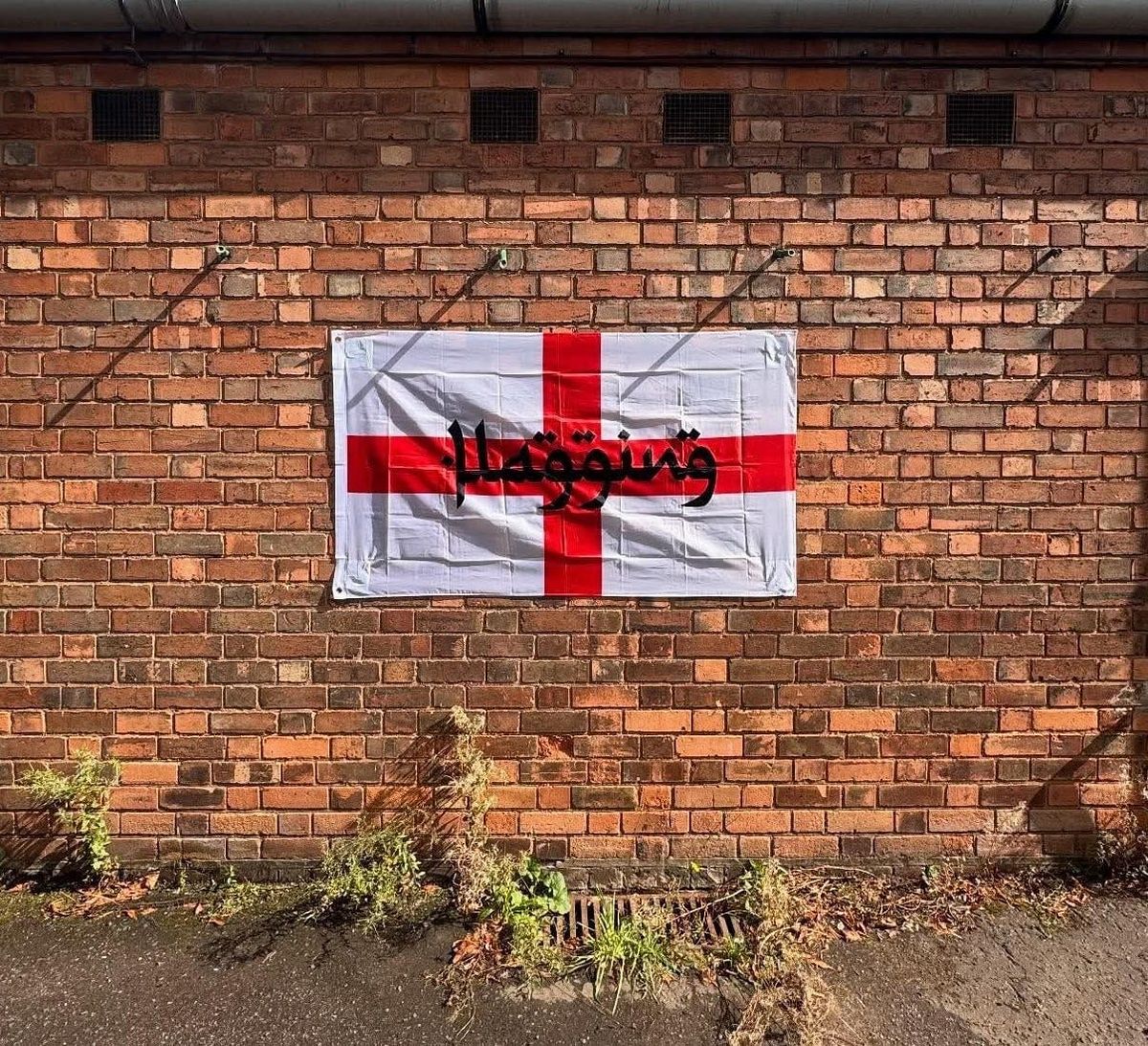
David Stark analyses the economic and cultural politics behind the war over flags that has erupted in Birmingham, and explores Stirchley is for Everyone's methods of community-based antifascist organising.
By David Stark
We are living through a global resurgence of right-wing authoritarian nationalism, which, it is claimed, indicates the collapse of progressive neoliberalism, an era in which expropriative and plutocratic economic programmes were combined with liberal commitments to multiculturalism and antiracism. In its stead, we are moving into a conjuncture of ‘not-yet-fascism’ or what Stuart Hall might have called ‘iron times’ – a condition marked not by fully fledged authoritarianism but by intensified nationalism, the erosion of human rights frameworks and the normalisation of previously fringe ideas, such as ‘remigration’. Birmingham is a lens both through which we can make sense of these transformations, and identify strategies of resistance.
The city has a longstanding association with far-right politics. Oswald Mosley assembled 10,000 people to a keynote rally held by his British Union of Fascists in Bingley Hall in 1934. In 1968, just half a mile up the road from Bingley, Enoch Powell delivered his ‘Rivers of Blood’ speech, a ‘patriotic’ call to white identity that was widely perceived to have shattered the UK’s post-war consensus on immigration, offering the template for a new form of anti-immigrant, identitarian politics. A handful of years later, Eric Clapton took the stage at the Birmingham Odeon, to declare that ‘Enoch was right’, and describe the city as a ‘Black Colony’’– inadvertently launching the Rock Against Racism movement in the process.
It’s the city Robert Jenrick comes to when he wants to generate social media content, warning voters of ‘the dark place’ Britain is heading to as a consequence of immigration and an alleged absence of integration, claiming it’s possible to spend hours in the city without seeing ‘another white face’; it’s the city Conservative peers compare to Weimar Berlin, claiming the Chief of Police is in the pocket of Islamist extremists; it’s the city where fascist groups march calling for ‘remigration’ and declaring that ‘Britain belongs to the British, and it’s about time they learned that again’. And it’s the city that’s been at the centre of a culture war over flags for the past 12 months.
Birmingham as a symbol of national decline
It is not difficult to understand Birmingham's significance within contemporary British political discourse. Birmingham City Council, the largest local authority in Europe, became the first council in the United Kingdom to issue a Section 114 notice, effectively declaring itself unable to meet its statutory financial obligations and precipitating a programme of severe service reductions. The crisis emerged from the convergence of more than a decade of austerity measures imposed by central government, escalating demand pressures, and local administrative failures. At the same time, Birmingham contains some of the highest levels of deprivation in the country, with child poverty rates in parts of the city exceeding 50 per cent.
Yet Birmingham's symbolic importance is not just economic. It is one of Britain's most ethnically diverse cities, with more than half of its residents belonging to minority ethnic communities. These characteristics have combined to make the city a powerful symbolic site within contemporary culture-war politics. Narratives of municipal failure, poverty, and service collapse are frequently intertwined with racialised accounts of migration, diversity, and social change, allowing Birmingham to be presented not simply as a city experiencing the consequences of neoliberal economic restructuring, but as evidence of a very particular form of national decline. In this framing, austerity, inequality, and political decisions recede from view, replaced by the suggestion that multiculturalism itself is responsible for social and economic breakdown. As Nigel Farage – in many respects Powell’s heir – has put it, ‘Britain is broken, (and) nowhere is as broken as Birmingham’. Reform UK held its party conference in the city, for the third year running, in September 2026.
Birmingham therefore occupies a distinctive place in the contemporary political imagination. It exists simultaneously as a materially impoverished city struggling with the consequences of (dis)organised abandonment, and as a symbolic battleground onto which wider anxieties about race, migration, belonging, national identity, and social cohesion can be projected. As such, it offers an important window into the ways in which authoritarian nationalist narratives transform structural crises into cultural and racialised ones, while obscuring the political and economic conditions from which those crises emerge.
Raising the colours: Everyday bordering and territorial nationalism
In the summer of 2025, in a context where anti-migrant rhetoric has become normalised and where frequently violent anti-immigrant demonstrations have become regular summertime fixtures, a rash of Union and St George’s flags began to appear on the lampposts of the suburbs of South Birmingham and selected villages in Worcestershire, rapidly working their way into the city and across much of the country. While the organisation behind the flagging campaign, Raise the Colours, initially presented itself as ‘a grassroots movement for unity and patriotism’ concerned with expressions of civic pride, it quickly became embedded within a broader politics of resentment in which nationalism, anti-migrant rhetoric, and narratives of cultural decline were increasingly intertwined. Evidently, the function of the flags was not merely to serve as expressions of national identity, but as territorial markers within an increasingly polarised political landscape in which nationalism, anti-migrant sentiment, and narratives of cultural decline have become mutually reinforcing.
This connection was reinforced by statements from the movement's leadership. As one of the group's founders, Ryan Bridge, explained, the organisation's principal concern was ‘to stop illegal immigration’: 'We're highlighting the fact that we're being invaded every day'.
Accordingly, the group’s activities escalated from simply hanging flags on suburban streets to explicitly targeted anti-migrant vigilantism in Northern France, during which both displaced people and NGO workers were targeted for abuse. Members of the group, including Bridge himself, have been permanently excluded from the country as a consequence.
In this light, the flags become transformed from benign expressions of community solidarity into symbols of everyday bordering: ordinary citizens are encouraged to participate in the policing of belonging. In so doing, neighbourhoods, streets, and public spaces are transformed into sites of informal border control, with those objecting to the flags display cast as ‘anti-British’ ‘traitors to their own country’.
This trajectory neatly exemplifies the dynamics of Seymour's not-yet-fascism. The issue is not the immediate emergence of a mass fascist movement, but the normalisation of ideas which would once have been confined to the political fringe: the representation of, particularly, young male asylum seekers – ‘fighting age men’ – as ‘an invasion’ or an internal enemy, the portrayal of demographic change as a form of ethnic replacement, and the framing of migration as an existential threat requiring exceptional measures such as ‘remigration’, or forced mass deportations.
Increasingly authoritarian responses come to appear reasonable, even necessary. The evolution of Raise the Colours illustrates this process clearly. Within a matter of weeks, a campaign ostensibly dedicated to civic pride and patriotism had become associated with violent anti-migrant vigilantism and an aggressive street politics in which calls to ‘deport the fucking lot’ functioned as an expression of a broader politics of expulsion and exclusion.
Neoliberalism from above, bordering from below
Framed as a reaction to abandonment, the ‘flagging’ movement is routinely presented as a revolt of the ‘left behind’, with commentators attributing the rise of authoritarian nationalist politics to politically organised white working-class rage. Such accounts, however, risk obscuring the social forces driving these mobilisations and the political interests they serve.
First, the social composition of these movements is often more complex than popular narratives suggest. The leading figures associated with Raise the Colours are in no sense representatives of Birmingham's ‘left behind’. For example, Ryan Bridge, the organisation’s co-founder and chief social media presence, describes himself as a businessman and reportedly resides not in one of Birmingham's deprived neighbourhoods, but in affluent suburban Bromsgrove. He is frequently featured in his social media livestreams driving a supercar. That point is not simply biographical. Rather, it highlights the extent to which contemporary nationalist mobilisation is frequently driven by sections of what Dan Evans identifies as a petite bourgeoisie of small business owners, self-employed entrepreneurs, and other groups who perceive themselves as simultaneously threatened from below and neglected from above.
This is significant because it disrupts simplistic explanations which understand anti-migrant mobilisation as a spontaneous reaction to deprivation: ‘white working class rage’. Birmingham's poorest residents, irrespective of ethnicity, undoubtedly experience the consequences of austerity, housing shortages, public service retrenchment, and economic insecurity. Yet the political narratives promoted by groups such as Raise the Colours do not direct popular anger towards the policies and institutions responsible for these conditions. Instead, structural problems are displaced onto racialised outsiders, with migrants represented as the cause of declining living standards, stretched public services, and national decline.
In this sense, contemporary anti-migrant mobilisation should not be understood as resistance to neoliberalism, a revolt of ‘the left behind’, but precisely as one of neoliberalism's political expressions. As economic inequality deepens, public institutions retreat, and abandonment is ever further entrenched, the social consequences of that abandonment are reinterpreted through the language of nationalism and cultural threat. Legitimate grievances are transformed into resentment, while questions of redistribution, belonging, class power, and state responsibility are displaced by demands for exclusion, deportation, and border enforcement.
The result is a politics that operates simultaneously from above and below: from above through the continued implementation of austerity, benefits cuts, and increasingly restrictive migration policies; and from below through citizen-led practices of bordering, surveillance, and intimidation directed at those constructed as outsiders. Rather than challenging the conditions that produced abandonment, such movements help to stabilise them by redirecting public anger towards migrants and away from the political and economic structures responsible for widespread insecurity.
A recent intervention by the Labour Home Secretary, Shabana Mahmood, illustrates the convergence of these approaches. During a live event in April 2026, Mahmood responded to hecklers challenging her promotion of ‘hardline’ immigration reforms regarded as analogous with those promoted by the hard-right anti-immigration Reform UK party by echoing the language used by Bridge and telling them to ‘fuck right off’. Prior to this, the then Prime Minister, Keir Starmer, had commented that he was ‘very encouraging’ of people flying flags.
Central to Mahmood’s response was the claim that criticism of her position represented an attempt to ‘delegitimise’ the ‘perfectly valid’ concerns of millions of people in this country about immigration. That formulation is analytically important. It situates her policy stance not as one political position among others, but as the articulation of legitimate popular will. Opposition is thereby reframed not as political disagreement, but as a challenge to the authority of ‘the public’ itself. And ‘the public’, implicitly, is authoritarian, nationalistic, and anti-immigration.
As Daniel Trilling has pointed out, the Trump administration’s conviction that Europe is facing ‘civilisational erasure’ as the consequence of immigration has been a key influence in Labour’s and Mahmood’s hardline anti-immigration stance. This position was keenly amplified by the world’s richest man, Elon Musk, who has used his ownership of the hugely influential X social media platform to promote the Great Replacement Theory, a previously fringe conspiracy theory invented by the French neofascist Renaud Camus which argues that Jews, with the collusion of the Western ‘liberal elite’, are conspiring to replace white Americans and Europeans with people of non-European descent, particularly Asians and Africans. Once considered outlandish, the theory has leaked from the fringes into the British political mainstream, with the likes of Rupert Lowe, MP for Great Yarmouth, explicitly espousing the doctrine.
Far from representing the authentic voice of a ‘left behind’ working class, then, individuals associated with Raise the Colours are articulating themes and anxieties that circulate at the highest levels of contemporary transnational right-wing politics. The discourses they reproduce are not local responses to exclusion, but components of a much broader ideological project linking nationalist movements across national boundaries.
On September 13th 2025, by video link, Musk addressed a public assembly of thousands of people convened by the far-right influencer Steven Yaxley-Lennon, aka ‘Tommy Robinson’, at his ‘Unite the Kingdom’ Rally. Musk concluded his address with the words: ‘whether you choose violence or not, violence is coming for you. You either fight back, or you die’.
The event was attended by Ryan Bridge and others associated with the ‘Raise the Colours’ movement. 12 days later, on September 25th2025, activists from Raise the Colours visited Stirchley for the first time.
Why Stirchley?
The Birmingham inner suburb of Stirchley is significant for several reasons. Geographically, it sits on the Pershore Road A441 corridor, and as such is on the cusp of cosmopolitan, urban inner-city Birmingham and the less diverse outer suburbs of South Birmingham and Worcestershire. Moreover, it has undergone significant demographic change in recent years, from being an area predominantly characterised as ‘white working class’ to one populated by a wave of millennial and Gen Z graduate-level professionals, priced out of more affluent areas of the city such as Moseley and Harborne and drawn to Stirchley by the relatively affordable – if rapidly rising – private housing rental market.
Stirchley is also notable for its concentration of independently owned cafés, bars, and small businesses, many of them organised along co-operative principles. The area has consequently acquired a reputation for being politically progressive, environmentally conscious, and broadly left-leaning. In this sense, Stirchley can be understood as emblematic of what Elon Musk has disparagingly termed the ‘woke mind virus’: a milieu associated with progressive social and environmental values. It likewise reflects what Ryan Bridge describes as the ‘middle-class ultra-far left’, a category he contrasts with the supposedly working-class constituency represented by his own movement.
Within this culture war framing, Bridge's claim to a working-class identity is itself revealing, given his objective class position as the director of a no-win-no-fee accident claims management company. His ability to accumulate and enjoy substantial wealth sits uneasily alongside such a self-identification. What is noteworthy here is that class is mobilised primarily as a cultural rather than material category. In this framing, the graduate renters of Stirchley are classified as middle class on the basis of their cultural capital – educational credentials, cultural tastes, and political dispositions – despite their often precarious relationship to housing and asset ownership. By contrast, the property-owning businessman is positioned as working class by virtue of his social origins. As Jonas Patrick Marvin has pointed out, in this discourse class functions less as a relationship to the ownership of capital or the capacity to exploit labour than as a marker of cultural identity and political belonging.
It is precisely this question of political belonging that has become contested in Stirchley. Between September 2025 and May 2026, Raise the Colours carried out flagging ‘operations’ on seven separate occasions, four of them in October 2025 alone. One such intervention was tellingly described in the organisation's own social media output as the ‘Battle of Stirchley’. This language is revealing. Stirchley was selected not despite its perceived hostility to the flagging movement, but because of it. Participants appear to have understood that their presence would be unwelcome and sought, through repeated public displays, to assert symbolic dominance over a population constructed as politically and culturally antagonistic. As Bridge excitedly declared during one Facebook livestream, ‘they hate us here’.
So, Raise the Colours members would drive into Stirchley, where they would attach flags to lampposts, blocking roads and pavements as they did so, and provoking confrontations with passers-by or with local residents who asked them to stop. They livestreamed these altercations, frequently ‘clipping’ and reposting particularly heated exchanges and presenting a social media circus with Ryan Bridge cast as ringmaster and abusing, belittling, and frequently threatening anyone offering him a sideways glance.
These actions can therefore be understood as attempts to demarcate the boundaries of legitimate belonging. The issue at stake was not simply the display of national symbols, but the assertion of who has the right to define the character of a place and represent its ‘authentic’ inhabitants. In this sense, flagging operates as a territorial claim-making practice, distinguishing between those deemed to belong and those cast as outsiders.
There are notable parallels here with broader anti-’woke’ discourse. Just as Shabana Mahmood criticises the ‘white liberals’ who, as she puts it, seek to police what she, ‘a brown woman’, is permitted to say, Bridge rails against Stirchley's ‘white middle-class liberals in pop-up bars’. Both construct themselves as marginalised or excluded voices confronting an allegedly hegemonic progressive establishment. Yet this positioning sits uneasily alongside their respective locations within structures of power. Bridge is a wealthy business owner, while Mahmood is a barrister who occupies one of the most senior offices of state as Home Secretary. What is striking, therefore, is not the accuracy of their outsider claims but the political effectiveness of a rhetoric that recasts socially and institutionally powerful actors as embattled dissidents resisting elite domination.
Similarly, those subjected to intimidation and harassment from the flaggers have reported repeated failures by the police to offer any form of protection: to the contrary, on at least one occasion, it has been reported that the police actually offered ‘an escort’ to the Raise the Colours activists, facilitating their activities. As one witness observed:
‘The police came to Stirchley in response to Raise the Colours putting up flags, and they just let them do it and film us. The police don’t want to call it ‘a police escort’, but I don’t know what else to call it. It’s ridiculous’.
This police’s non-intervention – or, at times, active co-operation – contributed to the movement's claim to legitimacy. Repeated ‘operations’ without significant state sanction or interference have allowed the participants to reinforce the legitimacy of their claims to be lawful representatives of ordinary public sentiment. This was invaluable PR for a movement simultaneously portraying itself as persecuted outsiders and as authentic representatives of ‘the people’.
This selective policing did not simply leave the conflict untouched or, as police representatives claimed, prevent a ‘breach of the peace’. Rather, it actively shaped the local balance of power. The actions carried out by Raise the Colours in the course of their flagging ‘operations’ – obstructing traffic, harassing and intimidating passers-by, affixing unauthorised items to street furniture – were indisputably ‘unlawful’ in the most routine and banal sense of that term, yet they were tolerated, if not indulged, by West Midlands Police.
This tolerance had political consequences. By failing to challenge activities that would ordinarily warrant sanction, the police contributed to the normalisation of the movement’s claims and practices. What mattered was not simply that the law was applied unevenly – ‘two-tier policing’, if you like – but that the flaggers’ positions on migration, belonging and national identity directly aligned with a broader dominant narrative, articulated across political, media and cultural spheres. While aggressive, confrontational, legally questionable, and intimidating, Raise the Colours’ activities were codified by those carrying the authority of the state as an expression of legitimate public concern, while those contesting them were positioned as outside the bounds of acceptable debate, and thus not deserving of the state’s protection: ‘fuck right off’, as the woman said.
In this context, the state's failure to challenge exclusionary territorial claims did not reduce tensions but intensified them. As formal mechanisms of protection appeared absent, the likelihood of direct confrontation increased. Violence, when it inevitably occurred, was therefore not an aberration from the dynamics established by the flagging campaign and the state's response to it, but a product of them.
The Battle of Stirchley: Territorial contestation and the politics of belonging
Following Raise the Colours' initial visit to Stirchley on 25 September 2025, during which residents who objected to the group's activities were subjected to verbal abuse and hostility, local opposition quickly organised. Concerned residents co-ordinated themselves informally and began removing the flags, rejecting what they saw as an externally imposed attempt to symbolically claim and redefine their community space. In response, Raise the Colours returned the following week equipped with a cherry-picker vehicle, enabling flags to be placed beyond easy reach. The operation was of course livestreamed, with activists openly anticipating and recording hostile reactions from local residents for dissemination on social media.
During this second visit, residents contacted the police to seek intervention. However, rather than addressing the intimidation and harassment that formed the basis of these concerns, officers were widely perceived as facilitating the operation’s continuation. As discussed above, several witnesses describe the police response as amounting to an informal ‘escort’, allowing the flaggers to continue erecting and filming their displays, with minimal interference. For many residents, this episode became an early indication that official ‘authorities’ were not willing to challenge Raise the Colours’ activities, despite growing concerns regarding intimidation, public disorder, and the group’s increasingly provocative attempts to establish a symbolic territorial presence within the neighbourhood.
Evidence later submitted in support of Birmingham City Council's application for an injunction against Raise the Colours provides further indication of the pattern that had developed. Police crime-log data covering the period from 1 September 2025 to 1 June 2026 recorded eleven incidents in Stirchley involving allegations of intimidation, assault, and harassment linked to the group. No further action was taken in relation to the first ten incidents. The final incident was recorded on 14 May 2026.
According to a statement submitted by a police sergeant informing this injunction application,
‘On 14 May 2026, police received multiple reports concerning males using a cherry picker to place flags on lampposts and allegations that local residents were being intimidated. Multiple incident logs were created and linked due to the scale of police demand generated.
The incidents escalated into significant disorder requiring police intervention. As a consequence of this disorder, a number of criminal investigations were commenced, including:
•Wounding.
•Three separate common assault investigations.
•A Public Order Act offence.
•Recovery of a knife from the scene.
The most serious allegation involved a report that a male had been struck by a vehicle and sustained a broken leg. Two arrests were made in connection with this investigation and enquiries remain ongoing’.
The vehicle in question was the cherry-picker truck routinely used during Raise the Colours' flagging operations. According to witness accounts, the individual who sustained the broken leg had attempted to prevent the vehicle from leaving the scene after one of its occupants allegedly assaulted several people in the street.
The incident occurred just one week after local elections in which Stirchley elected two Green Party councillors for the first time, including a Palestinian candidate who had taken strongly articulated public positions regarding Israel's actions in Gaza. Local Green Party activists had expressed their opposition to the flaggers’ activities, and indeed on occasion had participated in flag removals. Among many local residents, Raise the Colours' return to Stirchley, accompanied by a film crew, was widely interpreted as a form of punishment for this electoral outcome.
As one witness stated in evidence submitted to support the injunction application:
‘I believe that Raise the Colours have been deliberately targeting Stirchley, and filming it, because of the opposition they face here, in order to create spectacles for social media. One of their own videos shows Ryan Bridge arriving in Stirchley and telling his social media followers, 'they hate us here.' It seems that the potential for confrontation makes for a more exciting livestream, thus encouraging their followers to watch for longer and to donate more money. Of course, this incentivises ever-increasing provocation.
I cannot believe how little action has been taken so far, and it is no surprise to me that this laissez-faire approach has culminated in the events of last month. We have a great community here in Stirchley. I know we are stronger than these bullies, and I know we will prevail. But it is sad, and infuriating, that we have seemingly been left to look after ourselves, with so little support from the authorities’.
Stirchley is for Everyone
Facing this concerted, targeted harassment, residents began to organise more formally: they established a community organisation, Stirchley is for Everyone, a grassroots residents' campaign established to oppose Raise the Colours' flagging operations and to defend an inclusive vision of local community identity in Stirchley. The group’s website notes:
‘Raise the Colours use their flag campaign to intimidate, divide and threaten our community. The people of Stirchley and surrounding areas will not allow Raise the Colours and their Far-Right founders to turn our community into a circus.
We stand for a safe, inclusive Stirchley, and surrounding area, free from intimidation, where all people are respected and welcome’.
One of the group’s first scheduled activities was a ‘Family Day’ on a public square on Stirchley’s high street. Raise the Colours arrived early on the scheduled day, covered the area in flags and bunting, and then stood around the square, filming and goading participants during the event. Video evidence suggests that the police were aware of this and did little to intervene.
In response to what many residents regarded as a sustained campaign of intimidation, community self-organisation expanded considerably. A regional community hub was established, hosting coffee mornings, social events, and pay-as-you-feel classes in Muay Thai and strength and conditioning, intended to improve physical confidence and collective resilience. Alongside these initiatives, residents developed a direct-action network to coordinate the removal of newly erected flags. This led to the development of a bespoke flag-removal technique involving extendable cleaning poles and carpet tape, colloquially known as ‘the Stirchley method’. The technique proved sufficiently effective that advice, training, and practical assistance were subsequently shared, online and in person, with residents in other communities who similarly viewed themselves as targets of Raise the Colours' activities. In an ironic inversion of the flaggers' stated objective to promote ‘unity’, ‘deflagging’ sessions became participatory acts of community formation, frequently attracting up to fifty residents. What began as a practical effort to remove unwanted symbols of territorial domination evolved into a ritual of collective resistance through which neighbourhood solidarity was actively produced and reproduced in the face of fascist intimidation.
The significance of Stirchley is for Everyone extended beyond opposition to flagging operations alone. The organisation became a vehicle through which residents documented incidents of harassment, coordinated mutual aid and community safety initiatives, promoted counter-narratives to Raise the Colours' anti-migrant messaging, and mobilised support for legal and political challenges. An example of this was the group's maintenance of a detailed Baserow database. This document recorded 35 perceived incidents of violence, harassment, intimidation, and abuse involving Raise the Colours and members of the public in the period between September 25th 2025 and May 14th 2026 (after which date, applied bail conditions excluded the group’s core organisers from the area). The evidence collated significantly informed Birmingham City Council’s eventual decision, following a change of administration, to pursue an injunction in September 2026; for which, inevitably, they were rebuked by Elon Musk as ‘traitors’. Through these activities, residents transformed what began as a reactive effort to remove flags into a broader infrastructure of community self-defence, mutual support, and political mobilisation.
The organisation can be perceived as a locally rooted counter-institution through which residents have sought to reclaim agency over the governance and the meaning of public space, in the prolonged absence of any such governance from statutory bodies. The development of situation-specific practices such as the ‘Stirchley method’, the creation of support networks, the systematic documentation of incidents, and the enactment of collective resistance have all reflected an attempt to replace absent forms of institutional protection with collectively organised forms of community self-defence. Rather than merely resisting Raise the Colours' activities, residents constructed alternative mechanisms through which neighbourhood solidarity, safety, and territorial belonging could be asserted and defended.
Resisting Not-Yet-Fascism
More broadly, Stirchley's example demonstrates that territorial intimidation can produce forms of collective resistance which are themselves territorial in character. Residents did not merely contest Raise the Colours' political message, but rather challenged the flaggers' attempt to symbolically occupy and redefine their community space. The removal of flags, the organisation of community events, and the creation of networks for monitoring and documenting incidents have all represented efforts to reassert local control over the neighbourhood's symbolic landscape. The struggle in Stirchley is therefore not simply about competing political viewpoints, but rather about competing claims to place, belonging, and the right to define community boundaries.
As I have argued, the politics articulated by Raise the Colours within our present conjuncture of not-yet-fascism translate experiences of insecurity, uncertainty, and perceived decline into zero-sum demands for exclusion, surveillance, and symbolic territorial control. Social problems rooted in austerity, abandonment, and inequality are reinterpreted through the language of borders, belonging, and civilisational threat, producing a politics that directs anger towards racialised outsiders rather than the structures that generate insecurity.
The example of Stirchley is for Everyone, by contrast, demonstrates that abandonment need not inevitably generate authoritarian or exclusionary responses. Instead of responding to experiences of precarity and insecurity through practices of bordering and exclusion, the residents of Stirchley have sought to build networks of mutual support, resisting intimidation and violence, documenting abuse, and defending an inclusive and convivial vision of urban community – a Birmingham which, contrary to Nigel Farage’s viewpoint, is not ‘broken’. In doing so, it has offered a practical alternative to the politics of authoritarian nationalism, one grounded not in the identification of enemies but in the cultivation of solidarity.
The significance of this response extends beyond one inner-city suburb. If authoritarian nationalism represents a form of popular mobilisation that stabilises neoliberal abandonment by displacing social grievances onto migrants and other perceived outsiders, Stirchley is for Everyone points towards a different political possibility: the transformation of those same experiences of insecurity into collective organisation, mutual aid, and democratic participation.
In this sense, Stirchley is for Everyone offers a glimpse of what resistance to not-yet-fascism might look like: not the defence of an imagined past, but the collective construction of more inclusive futures.
David Stark is a writer, researcher and activist interested in migration, welfare, internal bordering and the construction of 'fairness'. His work combines critical social theory with empirical analysis to investigate how social policy and public discourse influence access to rights, resources and social inclusion.
Image credits: Faisal Hussain, uploaded @ X.

Comments ()